Embroidery fabric is one of the few materials where the buyer judges the mill on a swatch but lives with the result on a roll. A three-inch sample can be perfect and the sixty-yard roll can pucker, because the behaviour of an embroidered cloth depends on how the ground fabric, the topping, the thread tension and the finishing pass interact - and none of those are visible in a photograph.
China produces the majority of the world's embroidered yardage, and the industry is organised by cluster rather than by company. Keqiao in Shaoxing is the design and trading hub, with mills spread across Hangzhou's Xiaoshan plain and the coastal belt to Ningbo. Jiangsu's Shengze and Wujiang supply warp-knit grounds and do heavy lace work. Changle in Fujian runs the large raschel and lace looms. Guangdong's Foshan, Shantou and Dongguan carry the lingerie and African-market end of the trade, where speed on a new pattern matters more than archive depth.
The manufacturer notes below are drawn from company information the businesses publish themselves. The sourcing section at the end covers the measurements worth requesting before a strike-off is approved, because that is where most embroidery orders actually succeed or fail.
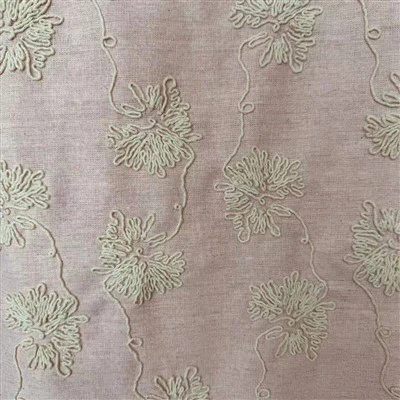
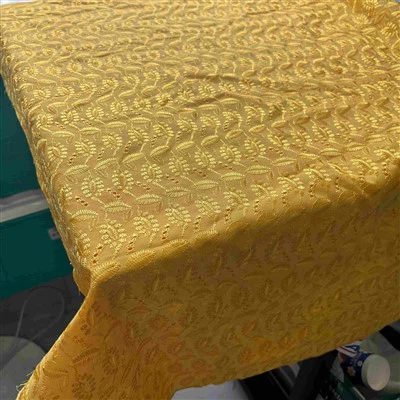
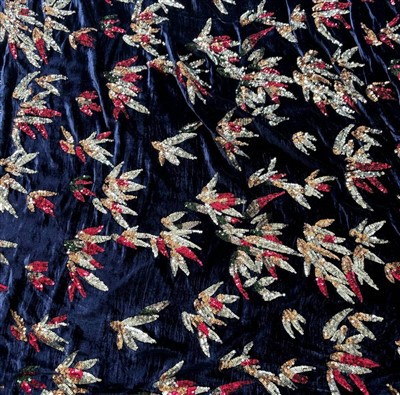
Most embroidery houses in China either run machines or trade designs. Shaoxing Omma Textile does both out of the same factory floor, and for a brand that is the difference between a sample that matches and a sample that has to be re-embroidered. The company was incorporated in 2019 and works across the families that matter most for womenswear and bridal: eyelet fabric, cotton schiffli, broderie anglaise, sequin fabric and chemical lace, also sold as guipure.
The mill sits in Shaoxing and runs roughly fifty embroidery machines of a Chinese advanced brand, Sinsim, with about forty sets working continuously on eyelet and chemical lace. That matters for repeatability: when the same machines, the same threads and the same tension settings stay on one pattern family, the second roll looks like the first. A dedicated inspection team and make-up stitch workers sit between embroidery and packing, so loose floats and broken floats are picked up before the roll is measured rather than after it ships.
What a buyer usually values most is the design archive. Omma holds more than 5,000 patterns available for reference, which shortens development when a collection needs a family of coordinated grounds rather than one hero cloth. Where a client brings their own artwork, the in-house designer prepares the custom sample and the team carries the project through to bulk shipment. Packing is set to customer requirement - rolled on tubes, folded on boards, or cut to marker length - which is a small detail that repeatedly decides whether a carton arrives usable.
|
Credentials
✓ 50 embroidery machines, Sinsim brand
✓ In-house inspection team and
make-up stitch workers ✓ Professional designer for
custom sample development ✓ OEM and ODM projects handled
from concept to bulk |
Scale and Reach
3,000 m² factory floor
Around 50 staff
40 machine sets on eyelet and
chemical lace Exports to South America, North America,
Dubai and Europe |
|
1
|
Ningbo, Zhejiang · Established 2008 |
MH works from Yinjiang Road in Ningbo's Jiangbei district and sits at the industrial end of the embroidery lace trade, with paid-in capital of RMB 60 million and around 110 staff on the 2024 social insurance filing. The company was set up in 2008 as the drawnwork arm of a group whose first weaving base dates to 2001.
Its drafting role in FZ/T 44006-2019, the industry standard for embroidery lace, gives it a seat in how the category is written down. Equipment includes Swiss Sullers looms alongside multi-head computer embroidery machines, and the range covers embroidery lace, cut-piece embroidery, water-soluble lace, dimensional work and both knit and woven embroidered grounds, supplied into more than 160 markets.
|
2
|
Hangzhou, Zhejiang · Established 2002 |
Ruifeng Hanyi, trading as Rainbow Classic, works out of the Badagong industrial zone in Guali town, Xiaoshan, on RMB 20 million of registered and paid-in capital. The founder moved from hand lace embroidery into woven home textiles in 2002, and the company now reports around 220 employees across a 28,000 m² site with 45,000 m² of workshop space.
Its registered activity is drawnwork and embroidery craft manufacture, and the production line has moved from hand work to automated equipment - the same shift the whole Xiaoshan belt made over two decades. For a buyer, the relevance is in scale of finishing capacity rather than machine count: a mill with its own cutting and sewing can deliver finished panels, not just yardage, which suits home-textile and ready-made programmes.
|
3
|
Rudong, Jiangsu · Established 2011 |
Rongxu is one of the larger weaving bases on the Rudong industrial belt, registered at RMB 55.86 million with roughly 216 staff on the social insurance roll. Its scope covers drawnwork and embroidery craft manufacture alongside knitting, bedding and garment production, with import and export handled in-house.
The company holds nineteen patents and fourteen software copyrights and has been recognised as a high-tech enterprise. The practical interest for an embroidery buyer is vertical: a mill that weaves its own ground cloth controls the base before a single needle touches it, which removes one of the commonest sources of shrinkage mismatch between sample and bulk.
|
4
|
Rudong, Jiangsu · Established 2016 |
Ruisheng was incorporated in 2016 in the Chengnan industrial park of Juegang, Rudong, with RMB 10 million of registered capital and around 197 staff on the social insurance roll. Its registered activity is drawnwork and embroidery craft manufacture, and the plant runs high-speed warping, sizing and air-jet looms.
Reported output runs above 40 million metres a year, and the company holds 56 patents covering functional finishes - antibacterial softening and mildew-resistant cloth among them. For a buyer sourcing embroidered yardage, that finishing capability is the point: the embroidered cloth is the expensive part, and it is the finish that decides how it behaves on the cutting table.
|
5
|
Xiaoshan, Hangzhou · Established 2002 |
Kaisheng works from Yonglian village in Guali town, Xiaoshan, on RMB 30 million of registered and paid-in capital with around 80 staff on the social insurance roll. The site covers 25,000 m² and sits about two kilometres from Hangzhou's international airport, which matters when a strike-off has to reach a European customer inside a week.
The plant runs roughly 120 machines, including Swiss Suller shuttle embroidery heads and specialised ribbon and tape embroidery units. Output is quoted at around 5 million metres a year, concentrated on cotton lace, bridal lace, water-soluble lace, continuous-sheet grounds and apparel fabric. Two granted utility patents cover an ultra-soft rabbit-hair lace fabric and an antibacterial antistatic lace, both aimed at the lingerie and childrenswear end of the market.
|
6
|
Shangyu, Shaoxing · Established 2003 |
Hualong works from the Zhangzhen industrial park in Shangyu, on the south side of the Shaoxing basin, with RMB 8.18 million of registered and paid-in capital and around 50 staff on the social insurance roll. The site occupies roughly fifty mu with about 8,000 m² of standard workshop, built with an investment reported at RMB 45 million.
The plant carries eight Swiss Lisui shuttle embroidery sets and quotes annual output of around 3 million metres of lace and embroidery cloth. The range is weighted toward the higher-value grounds - water-soluble work, TC cloth, mesh, bridal cloth and dimensional gauze - which is the segment where a mill competes on stitch definition rather than on price per metre.
|
7
|
Shengze, Jiangsu · Established 2002 |
Ruili works out of Shengtang village in Shengze, the warp-knit town inside Wujiang, with RMB 1.2 million of registered capital and around 50 staff on the social insurance roll. It has been registered since the end of 2002 and holds 34 patents and 11 trademarks across its embroidery range.
The scope covers fabric embroidery processing, lingerie and bedding production, and technical service for embroidery machines themselves - an unusual combination that means the company maintains its own heads rather than calling a contractor when a needle bar drifts. For a buyer, that shows up as tighter control of stitch registration across a long run, because the tooling is adjusted in-house rather than waited on.
|
8
|
Chaoyang, Guangdong · Established 2002 |
Lixiu was incorporated in 2002 in the Baotian Road industrial area of Gurao town, Chaoyang district, Shantou, with RMB 10.8 million of registered and fully paid-in capital and around 30 staff on the social insurance roll. Its registered activity is drawnwork and embroidery craft manufacture.
The plant sits inside the Gurao underwear cluster, where embroidery is consumed by the piece rather than by the roll. That shapes what it is good at: collar and panel work, narrow-width embroidery for trims, and small-lot runs where a Guangdong cut-make-trim operation needs a coordinated embroidery rather than a full container. Two premises are registered, one on Baotian Road and a second on Maoxin Road.
|
9
|
Changle, Fujian · Established 2003 |
Xinmei was incorporated in 2003 in Hunan town, Changle, with RMB 39 million of registered and fully paid-in capital and around 50 staff on the social insurance roll. The site sits in the Changle warp-knit belt, and the company's registered scope is lace, apparel fabric and industrial cloth manufacture with import and export handled directly.
The plant runs more than three hundred units of German Karl Mayer computer lace and high-speed warp-knitting equipment, and the company has been listed among Fujian's first batch of provincial industrial leading enterprises. The patent record runs past one hundred filings with a large body of registered design work, which is the more relevant figure in this category: lace sells on the pattern, and a deep design library is a real asset.
|
1
|
Ground shrinkage versus stitch pull
A woven ground and a knitted ground behave differently under the same needle. Woven cloth holds width but puckers along the seam line; knitted cloth gives in width and can narrow visibly across the roll. Ask the mill which ground class the sample used and whether the bulk will be the same construction, not merely the same weight and colour. A different base with the same specification sheet is the commonest cause of a bulk that does not match the approved strike-off.
|
|
2
|
Stitch density and the look of fullness
Density is usually quoted as stitches per centimetre, and two mills running the same design file at different densities will produce cloth that drapes differently. Higher density fills the motif but stiffens the hand and consumes more thread; lower density keeps the cloth soft but leaves the ground visible between threads under raking light. Insist that the density used on the approval sample is written into the purchase order, not left to the operator's habit.
|
|
3
|
Topping and backing removal
Water-soluble topping keeps the pile or the open ground from showing through the embroidery, and it has to come out afterwards. Ask how it is removed - wash, steam, or both - and whether the removal step is inside the quoted price. Residue shows up as a stiff patch and as thread that will not take a press. Backing on a stretch ground is a different question: too heavy and the cloth will not breathe, too light and the stitches distort when the cloth is pulled.
|
|
4
|
Pre-shrinkage and finishing
Embroidered cloth rarely returns to its original dimensions. The stitching restrains the ground, so residual shrinkage concentrates in the unembroidered areas and shows as rippling after the garment is washed. A pre-shrink and a controlled finishing pass reduce this but do not remove it. The number to request is finished width after embroidery and finishing, not before, along with a stated residual shrinkage limit.
|
|
5
|
Colour fastness and thread migration
Two separate risks live here. The ground's dye can bleed into the embroidery thread during finishing or later in wear, and a heavily pigmented thread can transfer onto a pale ground under pressure and humidity. Ask for wash and rub fastness figures on both the ground and the embroidery thread, tested after the topping is removed rather than before. Where the ground is a dark tone and the embroidery is white, migration is the more likely failure.
|
|
6
|
Pattern ownership and the sample archive
A large reference archive is an advantage for the buyer and a risk for the seller, so ownership rules are worth settling in writing. Establish which patterns are the mill's own stock, which are exclusive to a client, and what happens to an exclusive design after the contract ends. For a brand building a signature look, an unwritten exclusivity arrangement is worth nothing; a one-page agreement naming the pattern numbers is worth a great deal.
|
|
Schiffli
|
Machine embroidery on a shuttle loom, associated historically with Swiss and later Chinese production. Gives a dense, all-over pattern on a continuous length. |
|
Broderie anglaise
|
Eyelet work: the ground is cut and then embroidered around the opening so the hole is finished with thread. Usually irregular, floral or leaf-based, on a cotton or cotton-blend base. |
|
Guipure
|
Heavier lace in which the motifs are joined by bars rather than a continuous net ground. Often called chemical lace when the connecting ground is dissolved away after embroidery. |
|
Topping and backing
|
Topping lies on the face and stops the embroidery sinking into pile or an open ground; backing sits beneath and stabilises a stretch cloth. Both are removed later and both are quoted. |
|
Strike-off
|
A short embroidered length of the actual design on the actual ground, run before bulk. It is the only document that settles thread colour, density, ground behaviour and finish together. |
| Tony@ommatex.com | View Product Catalogue |
Tony +86 150 6857 9685 · Beyona +86 136 7688 4520