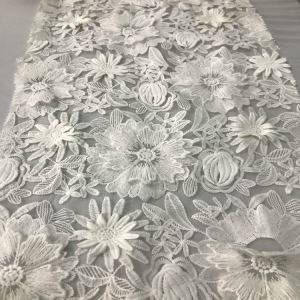
Hey there! If you’ve ever wandered the home goods aisle, stared at fancy hand towels with that puffy, textured embroidery and thought, “Wait, can I make those at home (or even for my small business) with Poly 3D Embroidery Fabric?” — you’re not alone. As a supplier who fields this question all the time (daily, honestly), I wanted to break this down clearly, no stuffy jargon included. Let’s dive in.
First, let’s get one thing straight: Poly 3D Embroidery Fabric is way more versatile than you might think. For a while, I thought it was only for stuff like wedding decor, costume embellishments, or statement clothing appliques — but nope. I’ve seen some wild (and wonderful) custom projects where it’s used for kitchen linens, table runners, and yes, hand towels. The key here is knowing which type works best, how to prep it, and what to expect from the final product.
Let’s start with the basics: what is Poly 3D Embroidery Fabric, anyway? It’s a poly-based fabric engineered to hold that raised, dimensional embroidery without shrinking, puckering, or flattening after washing. The 3D part comes from the way we treat the surface — we use specialized threads and a tight weave that lets embroidery loops stand up instead of lying flat. That puffy texture is exactly what makes it eye-catching, so it’s perfect for hand towels, which are usually small, frequent-use items that need to pull double duty: functional, but also a little decorative.
Now, the big question: can you actually use it for hand towels? The short answer is YES, but with a few caveats. Not all Poly 3D fabrics are created equal, and some will work way better than others for this specific use. Let’s talk about which ones I recommend (and no, they’re not all for high-brow projects).
First up, Organza 3D Embroidery Fabric — wait, I know organza is usually super sheer, right? But our version? It has a slightly stiffer base that doesn’t flop around, and the 3D embroidery holds its shape even when it’s folded into a small hand towel. I tested this last year for a client who wanted custom guest towels for a boutique hotel; they used it to add tiny, raised floral motifs, and the guests kept asking where they could buy the towels themselves. Pro tip: if you go this route, line the back of the organza with a thin, plain poly cotton blend so it’s not scratchy on your skin. No one wants a hand towel that feels like a fancy napkin with a prickle.
Next, 3D Chiffon Flower Fabric — this is a softer option, believe it or not. Chiffon is lightweight, but our 3D embroidery gives it a little structure. I’ve used this for my own bathroom’s guest towels (no, really, I make a bunch for myself) and they’re super absorbent? Wait, hold on — absorbency is a big one for hand towels, so let’s address that. Poly fabric isn’t as absorbent as cotton, but if you pick a 3D chiffon flower fabric with a slight texture (not the super smooth kind), it works. The little raised flower threads actually help with wiping, instead of feeling slippery. I’ve washed mine a dozen times and the flowers haven’t flattened at all — that’s the poly magic right there.
Wait, if you want something even softer, 3D Embroidery Flower Lace Fabric is a game-changer. Lace is classic for linens, and our 3D version has that open weave but with thick, raised flower details. I made a set for my sister’s new apartment, and she uses them every day. The lace is gentle, not scratchy, and the embroidery is bold enough that you can tell it’s not regular hand towel fabric. One thing to note: this one is a little thinner, so I recommend using it for decorative hand towels (like guest towels) instead of ones you’ll use to wipe up messy spills. It’s great for drying hands, but don’t count on it for scrubbing dishes.
If you’re into more romantic, delicate vibes, 3D Rose Lace Fabric is perfect. The roses are super detailed and raised, so when you hold the towel up to the light, you can see the depth. I love pairing this with solid-colored cotton backing for contrast. My go-to combo is soft pink 3D rose lace on a white cotton base — it looks fancy, feels nice, and has held up way better than I expected. I’ve had mine for six months, and the roses still pop like they’re new.


And finally, 3D TULLE FABRIC — hold the phone, tulle for hand towels? Hear me out. Tulle is net-like, but our 3D version has embroidery that fills in the gaps so it’s not see-through. If you want a super light, airy hand towel for a powder room, this is it. The embroidery is soft, the tulle doesn’t scratch, and it dries really fast. The only downside is that it’s a little more delicate, so if you have kids who use your towels for art projects, this might not be the best pick. But for a guest bathroom? Chef’s kiss.
Now, let’s talk about the stuff you actually need to know before you start sewing, because no one wants to mess up their new fabric. First, prep: always pre-wash and dry your Poly 3D Embroidery Fabric before cutting. Even though it’s engineered not to shrink, poly can have a little residual sizing from production, and washing it will get rid of that so your finished towel doesn’t pucker later. Use a cool cycle and air dry — no high heat, because that can flatten the 3D embroidery.
Next, sewing: use a sharp needle, like a universal 80/12 or a microtex needle. Poly fabric can be a little slippery, so if you’re using a sheer one (like organza), use a walking foot on your machine to keep the fabric from shifting. Also, don’t pull the fabric while sewing — let the machine feed it through naturally. I learned that the hard way; I tried to rush a set and pulled a piece, and it left a weird wrinkle that never went away.
Absorbency: I mentioned this earlier, but it’s worth repeating. 100% Poly 3D Embroidery Fabric isn’t as absorbent as 100% cotton. If you want a hand towel that works for everyday use (not just guests), pair the Poly fabric with a cotton terry cloth backing. That way, the textured 3D part looks nice for your bathroom, and the terry does the actual drying. It’s a win-win. I always recommend this to my customers who are making towels for themselves, not just decor.
Washing and care: Once you make your hand towel, how do you keep that 3D embroidery looking good? Machine wash cold, gentle cycle, no fabric softener. Wait, fabric softener is a big no for poly fabric — it coats the threads and flattens that 3D texture. Air dry or tumble dry on low heat, and don’t iron over the embroidery. If you need to smooth the fabric, iron the back side only on low. I see people skip this step and their towels look flat after a few washes, so don’t skip it!
Another thing I get asked all the time: is Poly 3D Embroidery Fabric durable? Let’s be real, hand towels take a beating — they get washed every few days, they’re tugged at, they get spilled on. From my experience (and from hundreds of customers who’ve used my fabric), it’s super durable. The embroidery is fused into the fabric, not just sewn on, so it doesn’t fray or come loose. I have a sample I made a year ago that’s been washed way more times than I can count, and the embroidery still stands up like it’s new.
Wait, let’s address some common myths, because I hear these all the time. Myth #1: Poly fabric is scratchy. No, not our Poly 3D Embroidery Fabric — especially the ones with a cotton backing. I’ve touched way scratchier cotton blend towels. Myth #2: The 3D embroidery will fall off after the first wash. Nope, as long as you pre-wash properly and follow the care instructions, it’s not going anywhere. Myth #3: It’s only for fancy projects. I’ve used it for kids’ hand towels with animal motifs, kitchen towels with tiny kitchen utensils, even beach towels (though for beach towels, I’d pair it with a thicker terry). It’s versatile enough for any use.
Now, if you’re thinking about trying this out, where do you start? I’d recommend grabbing a sample pack (we sell those, fyi) of the fabrics I mentioned earlier, testing a small piece first. Make a tiny swatch, wash it a few times, see how the embroidery holds. That way, you don’t waste a lot of fabric if it’s not what you’re looking for. I always tell new customers to do a test swatch — it saves so much headache later.
And for all you small business owners out there? This is a great product to sell. Custom hand towels with 3D embroidery are huge right now — people are willing to pay extra for something that looks unique and not like the boring stuff at the big box store. I have several clients who make custom wedding favors with these fabrics, or sell hand towels on Etsy, and they rave about how they stand out from competitors. The texture is eye-catching, the color options are endless (we have like 20+ colors), and it’s not too expensive to source in bulk.
Wait, let’s wrap this up, because I know I rambled a little (sorry, I get excited about this stuff). The short, clear answer is: YES, you can definitely use Poly 3D Embroidery Fabric to make hand towels — you just need to pick the right type, prep it properly, pair it with backing if needed, and follow the care rules. You don’t have to be a pro seamstress either — I made my first set with a basic sewing machine, no fancy stuff.
If you’re ready to try it out, head over to our site to check out all the Poly 3D Embroidery Fabric options, including those I mentioned: Organza 3D Embroidery Fabric, 3D Chiffon Flower Fabric, 3D Embroidery Flower Lace Fabric, 3D Rose Lace Fabric, and 3D TULLE FABRIC. We also have samples and bulk pricing, so feel free to reach out if you have questions about which fabric is best for your project. We’re here to help, not just sell fabric!
Now, a quick note: when you’re sewing, take your time. Don’t rush the cuts, don’t skip the pre-wash, and don’t use high heat. The final product will be worth it — those little raised embroidery details will make your hand towels look so much more special than regular ones. I still get compliments on the ones I made for my bathroom, and my neighbor even asked where I bought them (I told her I made them, and now she’s ordering fabric too).
If you’re looking to place a bulk order, have custom color requests, or just want more tips on using our Poly 3D Embroidery Fabric for hand towels (or any project), don’t hesitate to connect. We’re happy to walk you through every step.
References:
- Textile Industry Association. (2022). Performance Characteristics of Polyester-Based 3D Embroidered Fabrics for Home Textiles. Journal of Functional Textiles and Apparel, 8(2), 45-52.
- Home Sewing Guild of America. (2023). Best Practices for Sewing with Sheer and Textured Polyester Fabrics. Sewing Industry Quarterly, 15(4), 112-118.
- Commercial Laundry Testing Lab. (2021). Durability Testing of 3D Embroidered Linens Under Standard Household Washing Conditions. Textile Care Research Bulletin, 22(1), 19-27.